BYR 99 Prime Elements - kim heejo

BYR 99 Prime Elements


BYR Prime Elements establishes a unified system by correlating three distinct domains—human, nature, and the universe—with the chromatic and structural pairs of Blue–Square, Yellow–Triangle, and Red–Circle. However, this system does not operate as a fixed symbolic framework; rather, it functions as an open structure that is continuously transformed and reconfigured.
 
Each unit operates both as an independent formal element and as a relational node within the overall structure.
Through their combination, arrangement, and transformation, new states are continuously generated. In this process, the work does not culminate in a resolved form, but instead functions as a medium through which a mode of understanding and organizing the world is made visible.


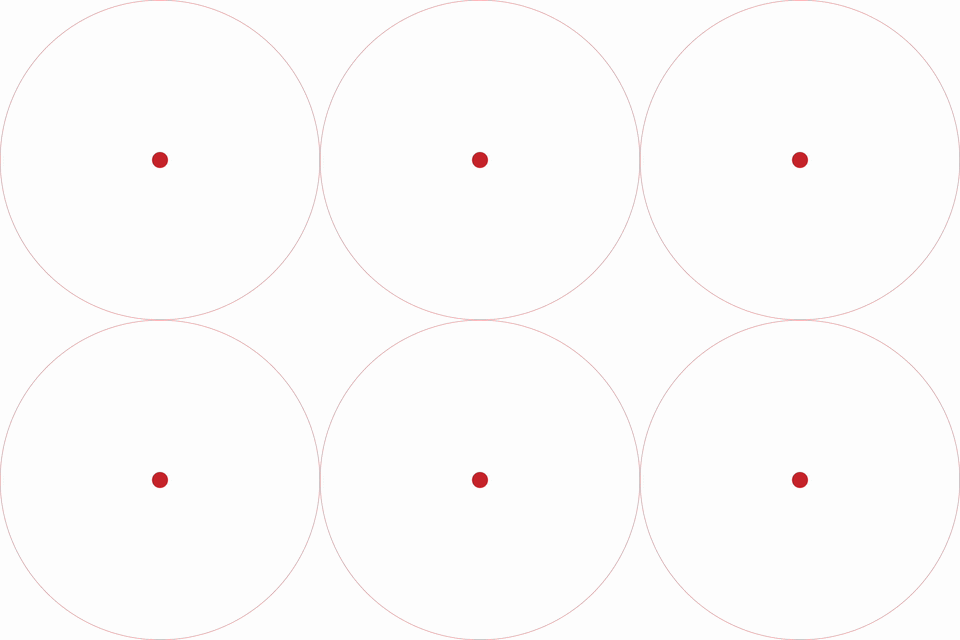
            
360° Structural Recomposition: The Schematic Rotation
 
BYR Prime Elements is therefore not a singular formal outcome, but a foundational structure of the Schematic Medium, integrating human cognition, natural order, and cosmic dynamics into a single system of thought. It does not aim at representation, but at the organization of relationships; not at fixed form, but at an ongoing state of generation. In doing so, it proposes a possible language of contemporary practice that moves beyond form toward structure, and beyond completion toward continuous formation.


BYR as Schematic Medium
 
BYR Prime Elements consists of 99 units—33 each of Blue, Yellow, and Red—forming a systematic structure based on three chromatic axes. Each unit takes the form of a circular object with a diameter of 18 inches (45.72 cm) and a thickness of 1 inch (2.54 cm), designed to rotate 360 degrees around a central axis.
 
This rotational capacity is not merely a physical feature, but a structural condition that presupposes continuous transformation and reconfiguration rather than fixed form. What is essential here is not the individual object, but the relational structure formed among the units. Each unit functions as both an autonomous formal entity and a component within a larger system, generating new configurations through processes of combination, arrangement, and variation.
 
This structure does not converge toward a finalized composition; instead, it operates as an open system that presupposes change and expansion. In this sense, BYR Prime Elements is not adequately defined within the conventional categories of painting or sculpture. It is more precisely understood as a Schematic Medium—a system that reveals the very process through which the world is perceived and organized.

 
Blue & Square as Human
Human as a Structure of Perception and Order
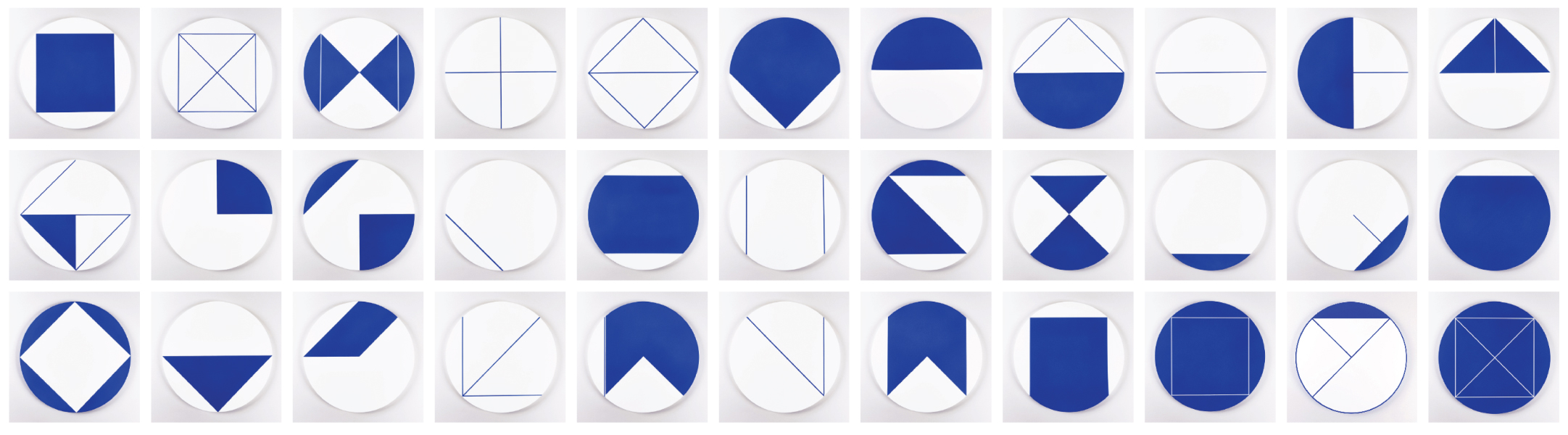
Blue consists of 33 units based on the square. The square, originating from four points, represents one of the most fundamental structural forms, embodying stability and order. From this basic configuration, the units expand into various formal states through omission, extension, transformation, and their interaction with circular forms.


Blue & Square: 33 Units of Human Condition
 
This process directly corresponds to the way humans perceive and organize the world. Rather than encountering reality in its entirety, human cognition operates through frameworks and structures that filter, interpret, and give form to experience. The square thus functions as a structural metaphor for these frameworks—norms, systems of order, language, and social constructs.
 
Blue & Square reduces the operations of human existence—conscious and unconscious processes, memory and experience, regulation and freedom—into a structural system. It does not describe the human condition through narrative or emotion, but redefines it as a set of conditions through which the world is perceived and structured.


Yellow & Triangle as Nature
Nature as a Structure of Harmony and Recurrence
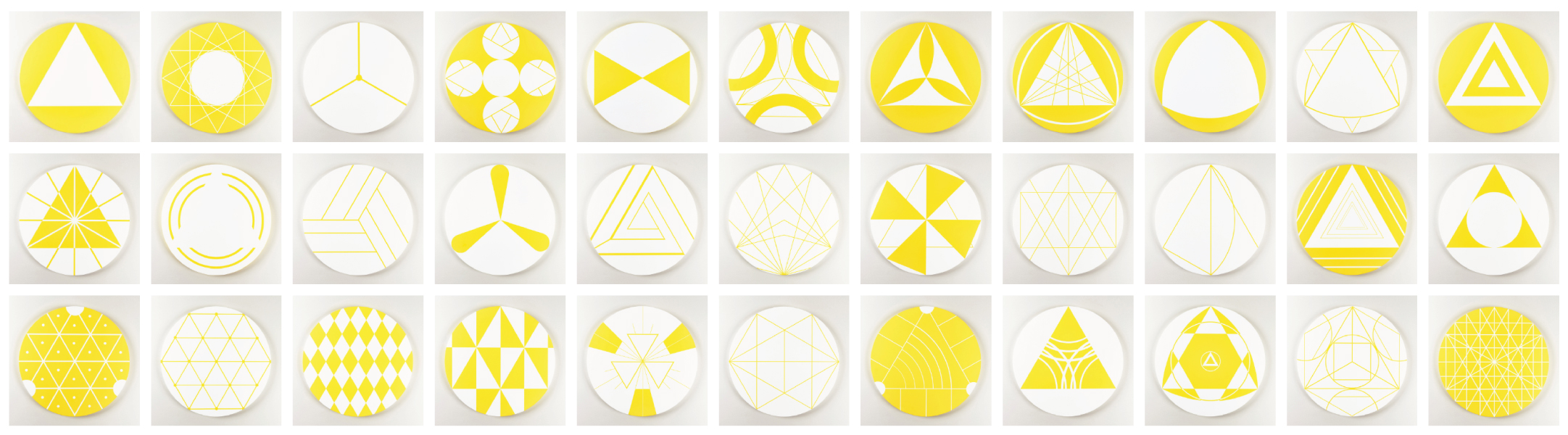
Yellow consists of 33 units derived from the equilateral triangle inscribed within a circle. The triangle, as the simplest stable geometric form, signifies the fundamental order and balance inherent in natural systems. These units generate a range of configurations based on principles such as repetition, symmetry, and rhythm.


Yellow & Triangle: 33 Units of Natural Order
 
This structure departs from anthropocentric perspectives and instead reveals the order of nature as a self-organizing system. Nature does not operate through intention or teleological direction; rather, it unfolds through cycles of repetition and variation, balance and disruption, generation and dissolution.
 
Yellow & Triangle presents these dynamics in an analytical and non-narrative manner. It does not represent nature as an image, but models the principles through which nature operates—harmony, rhythm, and recurrence. As such, this domain engages with a level of order that precedes and exceeds human systems of cognition.


Red & Circle as Universe
The Universe as Force, Flow, and Transformation
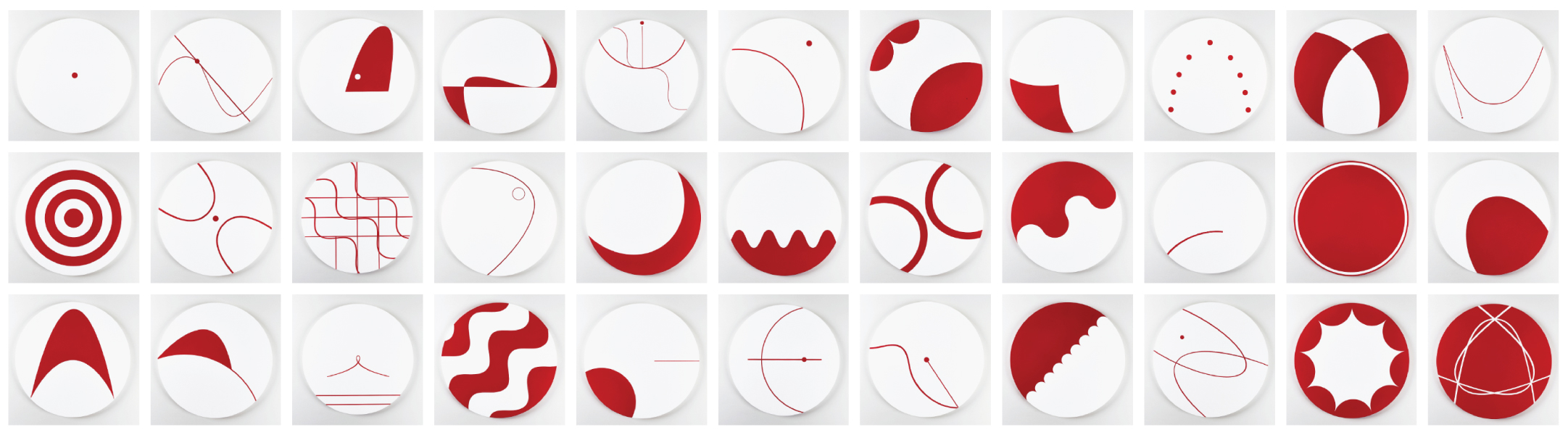
Red consists of 33 units that originate from the point. The point is both the origin of all form and a state without inherent directionality. Through its interaction with linear and curvilinear trajectories, it expands and shifts, generating a range of formal flows.


Red & Circle: 33 Units of Cosmic Dynamics
 
These flows evoke physical phenomena such as gravity, the movement of energy, orbital motion, and the propagation of light. Red therefore does not primarily concern form as a stable configuration, but rather the dynamics of force, transformation, and movement.
The circle represents the cyclical and expansive nature of these processes. Without a defined beginning or end, it embodies a continuous system of motion—generation and dissolution, displacement and reconfiguration.
 
Red & Circle presents the universe not as a fixed material entity, but as a dynamic system in constant operation. It articulates a perspective in which form is inseparable from force, and structure emerges from the continuous interaction of energies.

 
. . .


BYR Prime Elements articulates three distinct yet interconnected domains—human, nature, and the universe—within a single structural system. Each domain operates through its own schema, yet all are integrated within the broader framework of the Schematic Medium.
 
Rather than producing discrete objects, the work establishes a system in which form and concept are structurally organized and continuously reconfigured. In this sense, BYR Prime Elements does not represent the world, but reveals the conditions through which it is perceived, structured, and understood.


Schematic Studies: Circle Geometry


Circle Geometry is a digital drawing series developed in advance of actual object production, created to explore a range of geometric structures and formal relationships centered on the circle.

Schematic Studies: Schematic Objects Study from Circle Geometry


Schematic Objects Study from Circle Geometry is a body of work that extends the circle-centered geometric structures and formal relationships explored in Circle Geometry into actual objects, examining how planar schemata may be transformed into spatial form.

Schematic Studies: Schematic Painting Study from Core Searching Drawings


Schematic Painting Study from Core Searching Drawings is a body of work that extends the semicircle-based formal structures explored in the earlier Core Searching Drawings into the field of painting. Reconstructing the basic forms developed through drawing within a painterly surface, this series combines color, light, and variable visual perception in order to generate a new sensory order. It is therefore not simply a translation of drawing into painting, but a pictorial

Schematic Platform no.1


Schematic Platform no.1 is an installation work that presents the overall concept of Schematic Medium by organizing drawings, paintings, objects, and structural elements into a single integrated spatial formation. Rather than displaying individual genres side by side as separate categories, this work brings together the different formal languages developed over time and activates them as one unified work.

Pattern Studies


Pattern Studies is a body of work centered on pattern as one of the formal elements of Schematic Medium, exploring how repetition, arrangement, color, and rhythm generate structure within the picture plane. In this series, pattern does not function as a merely decorative device or surface repetition, but as a key formal principle through which visual order and sensory rhythm are constructed.

Face Series


The Face series is a body of paintings centered on the human face. Moving beyond conventional portraiture, the works explore emotional and psychological traces of human presence through color, brushstroke, composition, and expression. Each painting articulates the individuality and atmosphere of its subject through painterly means.

Genetic Clones: Hello! Dolly!


The sheep that appear on the surface maintain a consistent formal structure, yet emerge in different states through variations in color, composition, and surface treatment. Here, the figure of the sheep is treated not as an object of realistic representation, but as something reduced to a simplified unit of form. The body and face are constructed through the relationship between concise masses and planes, while descriptive detail is deliberately restrained. This reduction does not aim to explain the subject concretely, but to reveal how form itself is organized and transformed.